‘Royal Fanfaronade’ and Prussian grandeur
TEXT: CORNELIA BRELOWSKI
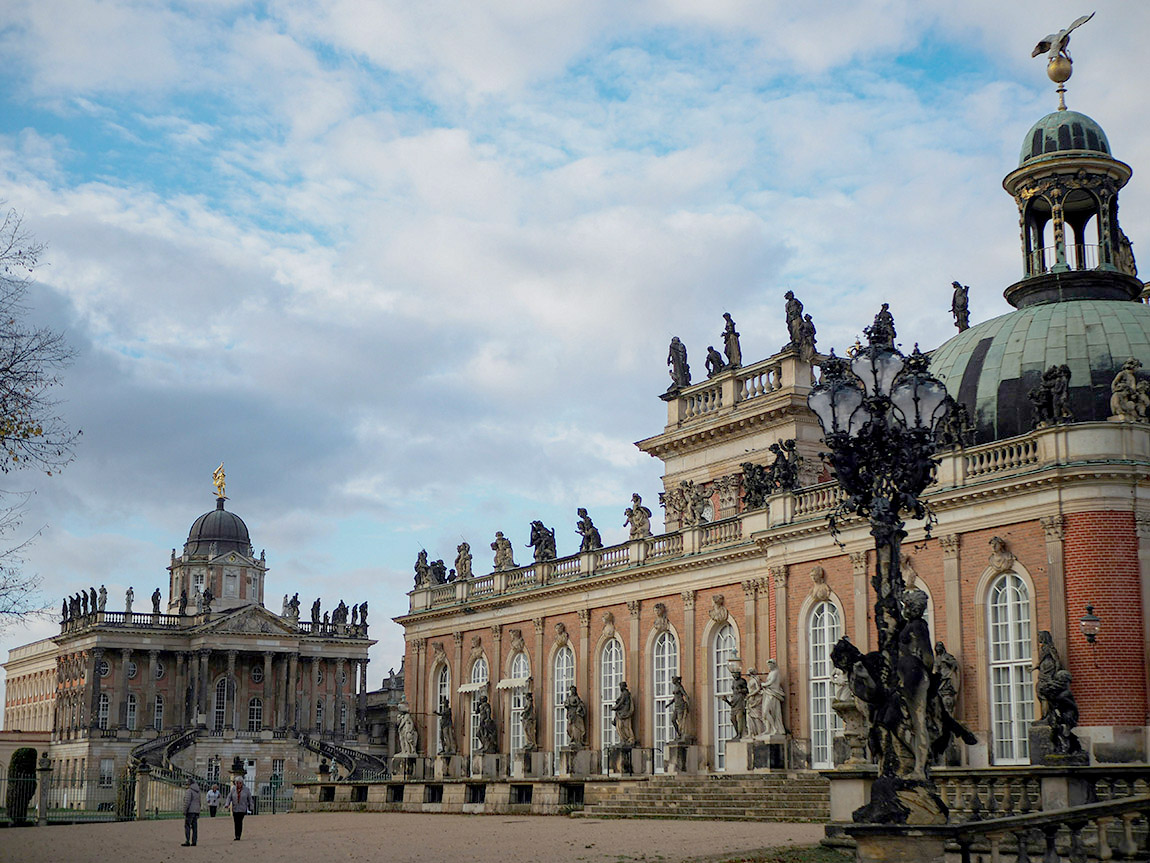
Neues Palais, garden side exterior detail. Photo: Florian Peeters on Unsplash
Dubbed a ‘fanfaronade’ – meaning a boastful display – by its creator Frederick the Great, the Neues Palais in Potsdam’s Sanssouci Park was conceived as a symbol of royal power following Prussia’s victory in the Seven Years’ War. Our writer Cornelia Brelowski went on a guided tour to find out more about the imposing building’s history.
Built between 1763 and 1769, and designed by Johann Gottfried Büring, Heinrich Ludwig Manger and Carl von Gontard in the ornate Rococo style, this palace not only functioned as a summer residence for Prussian royalty but also hosted the family of the last German emperor, Kaiser Wilhelm II, who spent several months there each year, including over the Christmas period.
Coming from the direction of the Sanssouci castle, you need to walk around the building and enter the Neues Palais (New Palace) on its garden side. Directly opposite, the surprised visitor is faced with a replica of the structure, the centre of which presents a triumphal arch. It was through this arch the carriages of the king’s guests entered the premises, as the Neues Palais served not only as representative residence but also as an imposing guest house. The side wings of the replica housed the servant quarters and kitchen, meaning that for many years, hot dishes had to be carried across the grounds by servants al fresco and then reheated in a warming room at the castle.
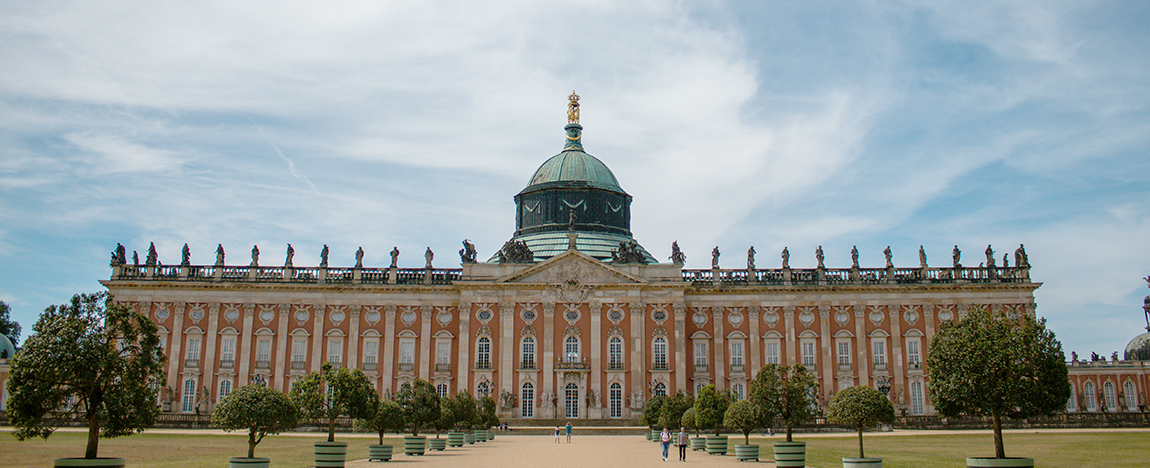
Neues Palais (New Palace). Photo: Karel Mistrik on Unsplash
Frederick the Great is said to have shunned the design of the Neues Palais in hindsight, complaining about the disproportionate size of the statues decorating the facade, which to him seemed too large. His aesthetically oriented mind preferred the humble proportions of his soul home, the one-storied castle of Sanssouci, set at the top of a vineyard far away at the other end of the park. However, he brought much of his own taste to the interior of the New Palace, for example large murals already commissioned before the war, a library containing 2,000 books as well as an in-house theatre for concerts.
Frederick had wanted a building in the Palladian style. He considered Castle Howard in England to be exemplary, and it must be said that the likeness is undeniable, through to the rather tall statues lining the roof. A classicist building in Amsterdam, Trippenhuis, also served as inspiration, mirrored in parts by the house at Am Kanal 41 in Potsdam – which he built while the country was still at peace, in order to test the construction method of exposed brick with ashlar that he had admired during an earlier visit in the Netherlands.

Neues Palais, interior detail. Photo: Cornelia Brelowski
The building’s representative display function was served not least by its abundant sculptural decoration. The iconography suggests that the building was intended to serve as a monument to Frederick himself as a victorious military commander, underscored by the programmatic inscription “Nec soli cedit” (“He yields not even to the sun”) on the cartouches of the middle risalits. Thus, his personality presents one of the most contradictory in the history of Prussian leaders: a sensitive, artistic soul at heart, who became one of the toughest war mongers of his time, Frederick was eternally split between his yearning for peace, music and philosophy (symbolised by the Sanssouci castle) and the role the world had thrust upon his shoulders (represented by the New Palace).
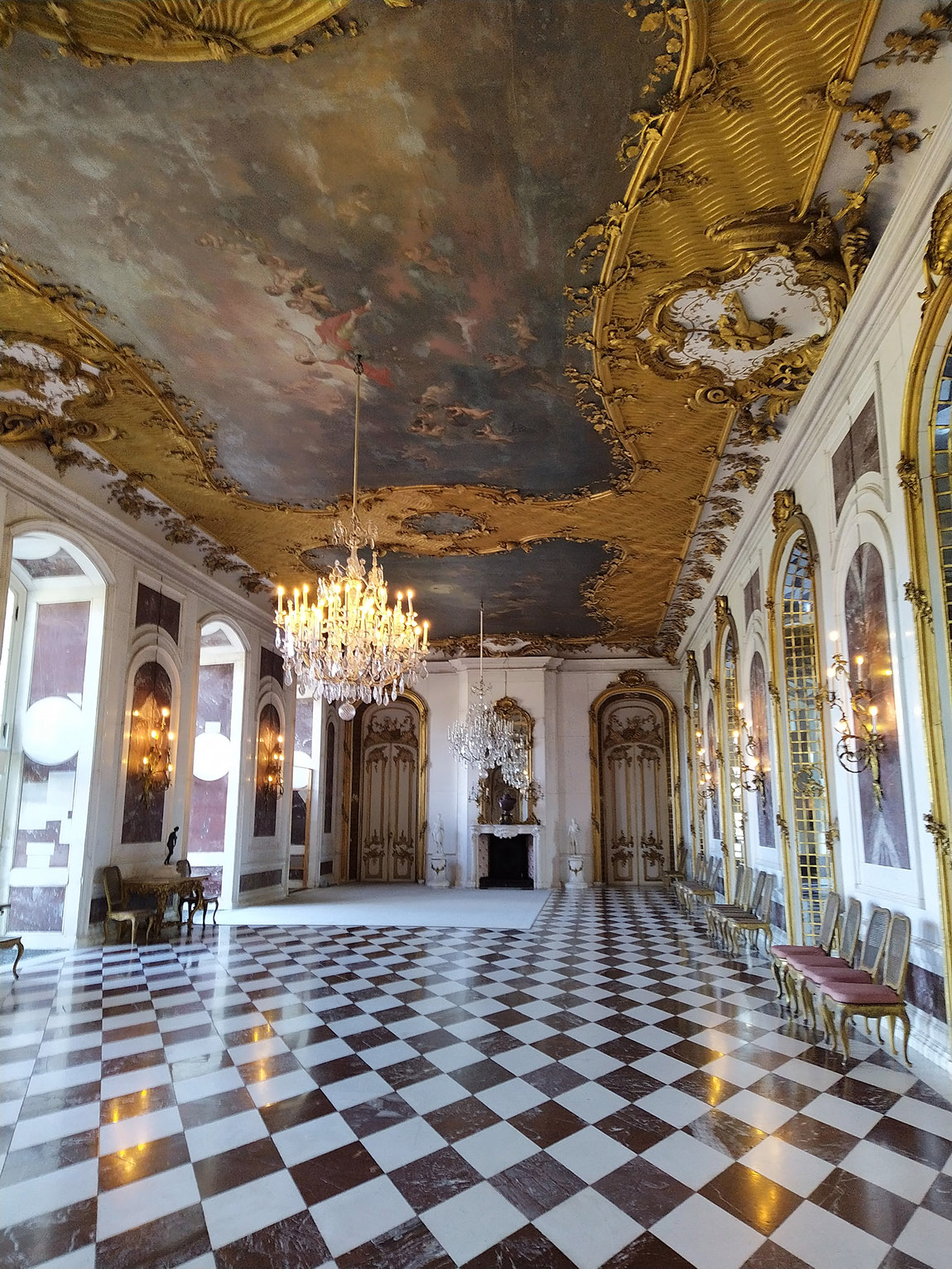
Marble Gallery. Photo: Cornelia Brelowski
To feel more at home, he copied numerous details from the Sanssouci rooms, through to copies of his favourite books from the Sanssouci library. His reading room, a simple, small room with a low ceiling, was the book lover’s refuge. While walking the rooms nowadays open to the public, visitors might also note a garden room with a curved wall which seems different to the otherwise heavy interiors of the ground floor salons. With its comparatively light-hearted air and nature theme, it may have well been inspired by the Voltaire Room in Sanssouci – an interior homage to Frederick’s admired philosopher guest.
With a total of 200 rooms, three stand out especially at Neues Palais: the grotto hall, the marble hall, and the concert hall are particularly impressive. The concert theatre, currently not open to the public, was also meant for concerts by Frederick the Great himself – who liked to entertain his guests on the traverse flute, which he had initially learnt to play in secret so as to not enrage his strict father. Once having become king himself, he influenced and improved Berlin’s music scene profoundly. He even had the Berlin opera house built on Unter den Linden, where mainly Italian opera was performed, for whom the poet king also wrote several libretti.
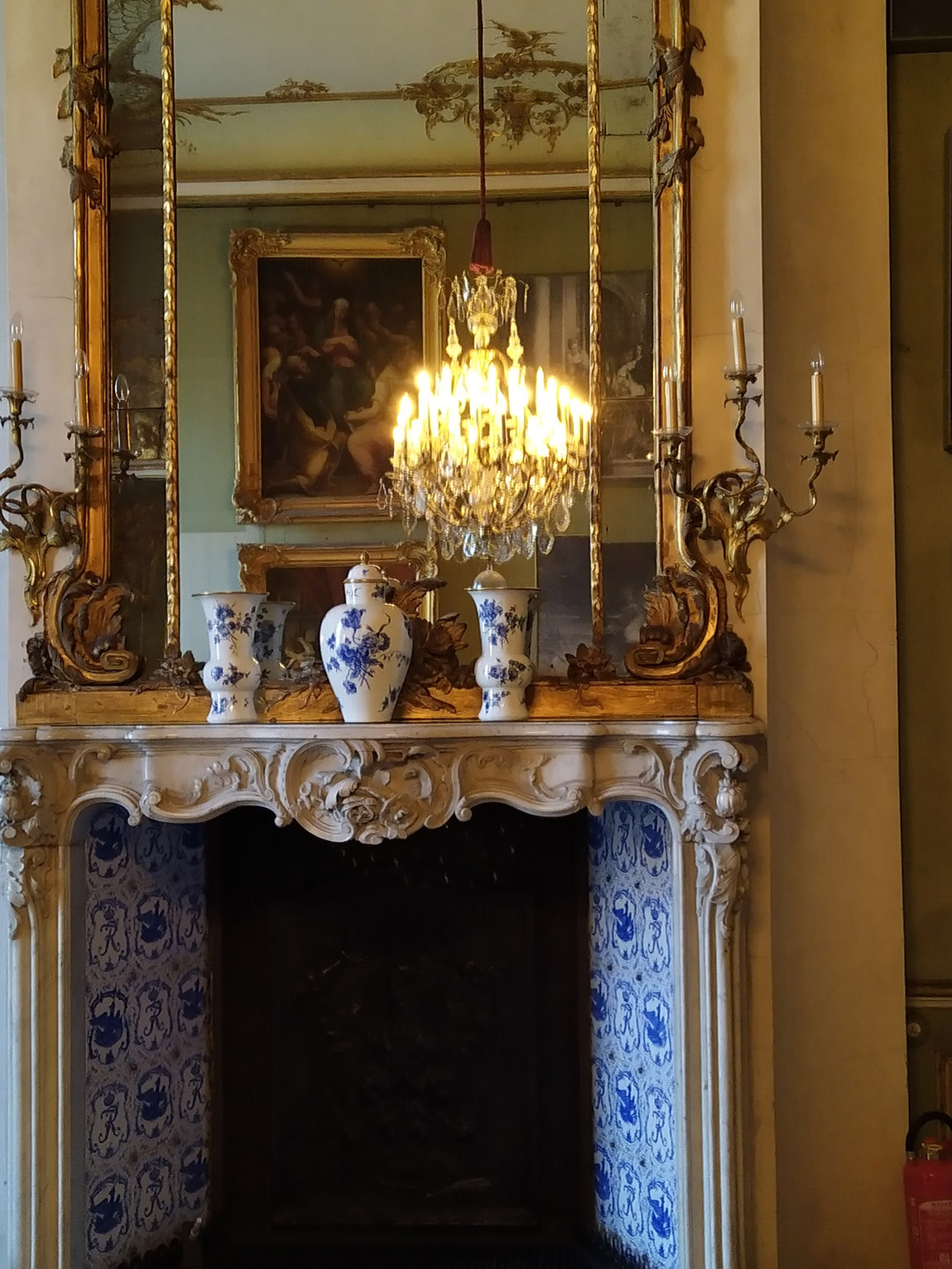
Open fireplace. Photo: Cornelia Brelowski
On starting the guided tour, you are first met by the imposing grotto hall, which greets visitors with an overwhelming load of multiple designs made of shells, glass, and minerals from all over the world. Here, the last emperor’s family spent their Christmas evenings, with a tree put up for every child, as well as two slightly taller ones for Wilhelm II and his wife Auguste Viktoria. The latter, by the way, had the only lift installed at the Palais, a technical novelty back then – due to her aching back which may have suffered in the chilly temperatures – as well as the tinniest cubicle for hot baths, attached to the royal bedroom and closable like a wardrobe to retain the heat. The emperor’s family was the first (and last) to use the Palais for several months a year, so electric lighting, telephone, and other comforts were soon to follow. Even a central heating system was installed. The original, beautifully decorated open fireplaces meanwhile were only suitable for heating to a limited extent and merely served as a status symbol.
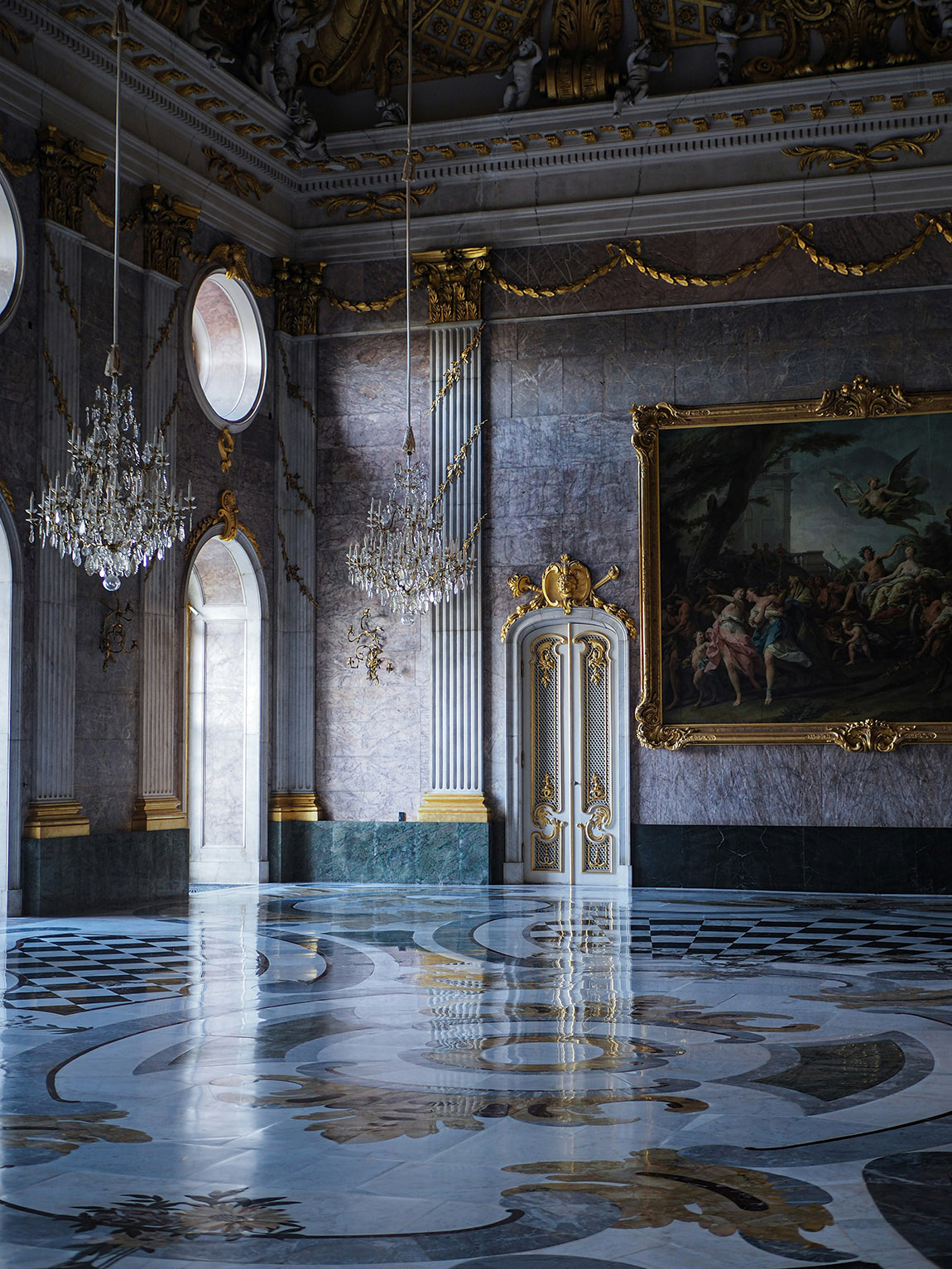
Marble Hall. Photo: Florian Peeters on Unsplash
In terms of murals and ceiling decorations, the Marble Gallery is particularly noteworthy, featuring exquisite ceiling paintings by Christian Bernhard Rode who originally also designed the ceilings of the Grotto Hall, which unfortunately have not been preserved. The Marble Hall, meanwhile, serving as a central ballroom, was designed by architect Carl von Gontard, and was based on the model of the Marble Hall in Potsdam City Palace. Its four large-format murals had been commissioned by Frederick the Great even before the Seven Years’ War.
Finally, the Upper Gallery south of the Marble Hall is not to be missed. It took three decades to reopen and features five of Frederick’s most valuable baroque paintings. Here, the permanent exhibition Die Rückkehr der Bilder (The Return of the Paintings) shows two out of three existing paintings in German possession by the only known female baroque painter Artemisia Gentileschi. They are both beautifully restored and presented together with – or contrasted with – equally restored works by male contemporaries Guido Reni and Luca Giordano. It was not until the 20th century that the two paintings were discovered to be by Gentileschi. The Prussian king probably acquired the works without knowing that they had been created by a female painter. Today, they are the focus of growing art-historical interest in Gentileschi’s work.
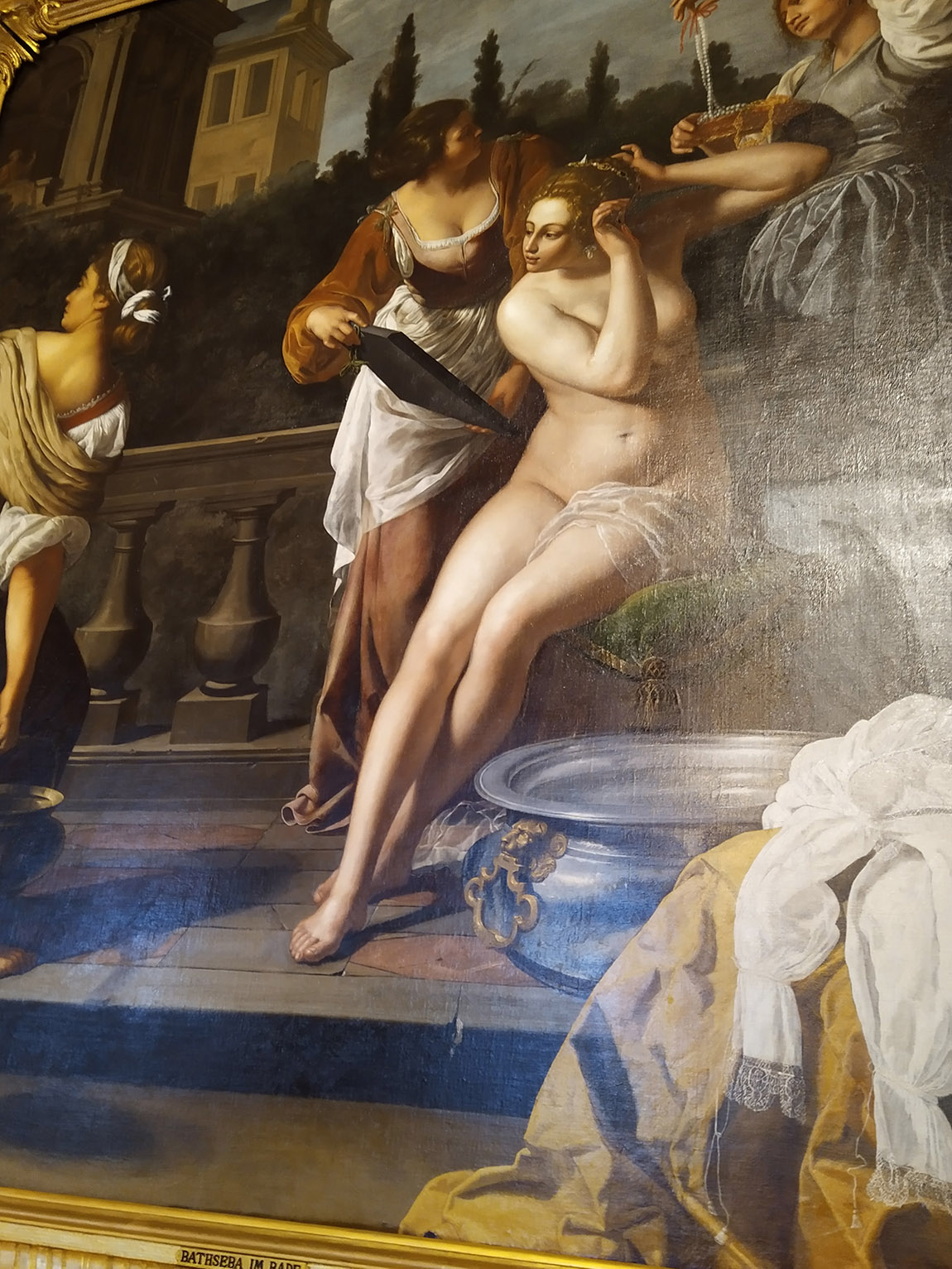
Artemisia Gentileschi – Bathsheba at her Bath, ca. 1645-1650. Photo: Cornelia Brelowski

Subscribe to Our Newsletter
Receive our monthly newsletter by email